
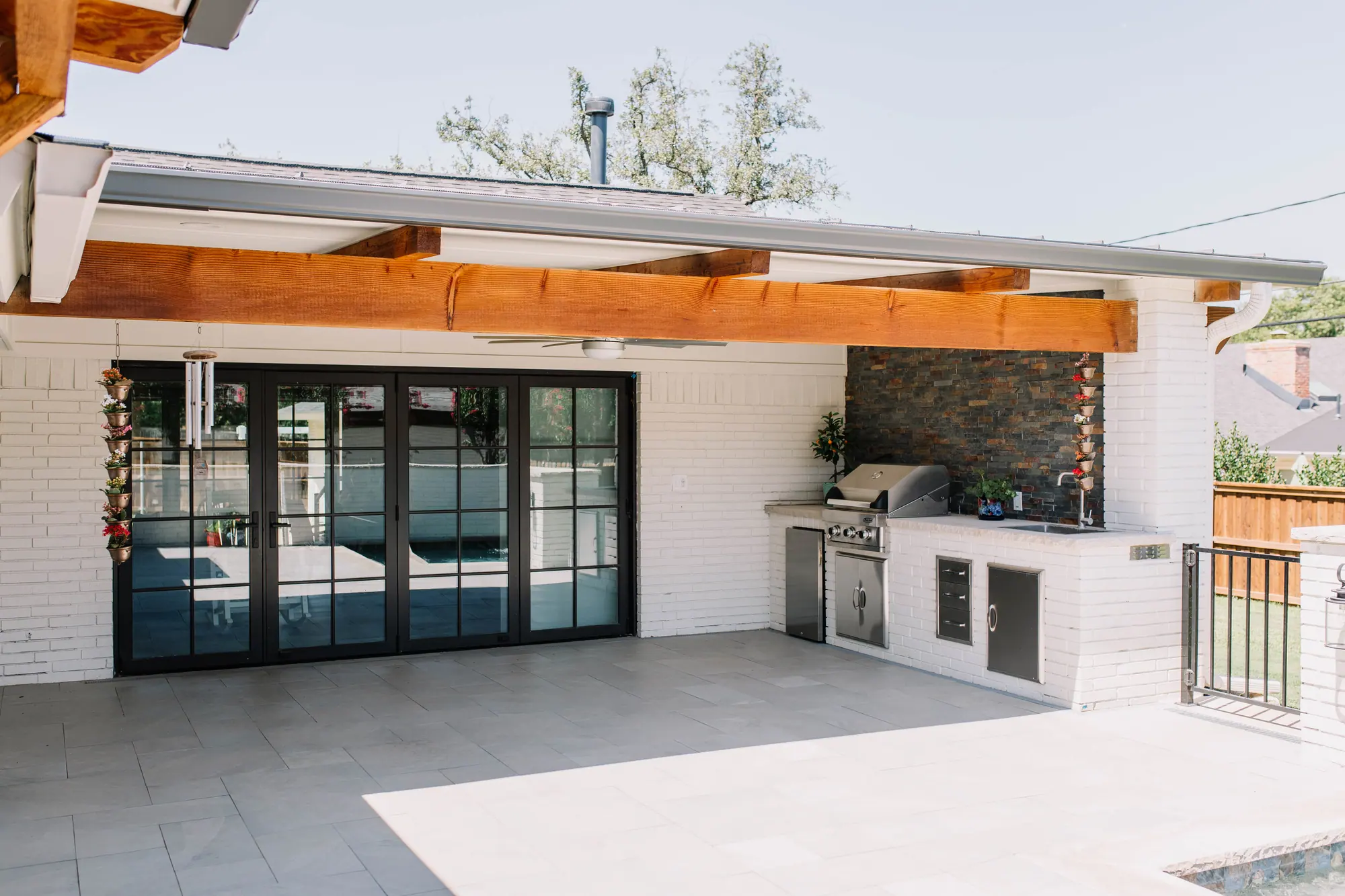
Patio cover and pergola permits · Fort Worth
Do you need a permit for a patio cover or pergola in Fort Worth?
Yes. A patio cover or pergola in Fort Worth takes a building permit, and no size is exempt.
Or call or text (817) 631-9803
From the City of Fort Worth’s Residential Permitting page, its Administrative Code and its permit type descriptions, read November 12, 2026.
The City’s rule
Patio cover and pergola permits in Fort Worth: what the City requires
Attached or freestanding, it takes a building permit. What changes is which one. A cover attached to the house is filed as an addition. A pergola or pavilion standing on its own is an accessory structure.
“All additions require building permits.”
The City’s permit: Residential Addition. Its example: “adding an attached covered porch or patio cover”
The home addition permit in Fort Worth
Walls, screens or glass on a patio cover have a rule of their own.
“All accessory structures require a building permit. This may include gazebos, outdoor fireplaces, fountains with plumbing, wind turbines, solar panels, radio towers, swimming pools, retaining walls, etc.”
The City’s permit: Residential Accessory New, for an accessory structure built from the ground up. A cover added to a pool house is a Residential Accessory Addition.
City of Fort Worth, Residential Permitting, read November 12, 2026, and its Residential Permit Descriptions sheet, dated June 29, 2020.
Show us where the shade should go, and we’ll tell you which one yours is.
The exemption list
Is a small pergola exempt from a permit in Fort Worth?
No. Fort Worth writes down every kind of building work that needs no permit, nineteen items in all. A patio cover or a pergola isn’t one of them, at any size. You’ll find a 200-square-foot exemption repeated online. It isn’t on Fort Worth’s list.
Building work the City of Fort Worth lets you do without a permit, from its Administrative Code §105.2, in plain words. Several items carry conditions, and the City’s text governs. Read the City’s list
- Item 1: Flagpoles under 20 feet, or wall-mounted ones under 10 feet
- Item 2: Fences up to 7 feet, and open wire fences without slats up to 8 feet (not electric barrier fences)
- Item 3: Oil derricks
- Item 4: Retaining walls up to 4 feet, from the bottom of the footing, that hold back no added load or flammable liquid
- Item 5: Water tanks on the ground, up to 5,000 gallons and no taller than twice their width
- Item 6: Platforms, walks and decks 6 inches or less above the ground “Platforms, walks and decks not more than six (6) inches above grade and not over any basement or story below.”
- Item 7: Painting, wallpaper, tile and carpet, and replacing cabinets or counter tops
- Item 8: Temporary movie, TV and stage sets
- Item 9: Prefabricated pools set entirely above ground, up to 5,000 gallons
- Item 10: Concrete pads for mechanical and electrical equipment outside the house
- Item 11: Swings and playground equipment
- Item 12: Window awnings hung on the house wall, 54 inches deep or less, with no added support “Window awnings on Groups R-3 and U occupancies supported by an exterior wall that do not project more than fifty-four (54) inches (1372 mm) from the exterior wall and do not require additional support.”
- Item 13: Movable fixtures, racks and partitions up to 5 feet 9 inches
- Item 14: Roof repairs above the decking, sheathing or lathing boards
- Item 15: Demolition by the State of Texas for highway widening
- Item 16: Flammable liquid tanks with a Fire Department permit (their foundations still take one)
- Item 17: Freestanding satellite dishes up to 40 inches across and 12 feet tall
- Item 18: Door replacements that keep the same framed opening, outside designated historic districts
- Item 19: Job trailers on a commercial construction site
Not on the list: a patio cover, a pergola, a gazebo or a pavilion, at any size.
The nearest cases are a low deck and an awning hung on the wall. Put posts under that awning and it’s no longer item 12. City of Fort Worth, Administrative Code, Ordinance No. 25387-03-2022, §105.2, read November 12, 2026.
Planning a cover or a pergola? We’ll tell you which permit it takes.
On your lot
Where a patio cover or pergola can go on your lot
The permit isn’t the only rule. The City’s zoning sets how close a cover comes to your property lines, how tall a freestanding one gets, and how much of the lot can sit under a roof.
- Front property line
- Street
- A roofed porch or patio: 15 ft back, 10 ft on a limited local street
- Rear wall of the house
- Standing on its own: behind the rear wall, or 75 ft from the front property line
- Attached: filed as an addition
- The district’s side and rear setbacks
- Every roof counts
- The area under every roof on your lot, the house’s included, counts toward your district’s lot coverage limit.
- Toward the street
- An open porch or patio with a roof on posts can come no closer than 15 feet to the front property line on a local street, or 10 feet on a limited local street. A freestanding structure can’t go in the front yard.
- Standing on its own
- It goes behind the rear wall of the house or at least 75 feet from the front property line, stays one story, and stands no taller than 10 feet, or 12 if it sits 2 more feet beyond the district’s side and rear setbacks for each foot over 10. A pavilion joined to the house by a breezeway or covered walkway whose roof isn’t part of the house’s roofline still counts as standing on its own.
- Ask the City
- Fort Worth also caps the total square feet of accessory buildings by lot size: 200 square feet on a 5,000- to 9,999-square-foot lot. Ask its zoning desk whether your pergola counts toward that total before it’s drawn.
City of Fort Worth Zoning Ordinance §5.301 and §6.101, read November 12 and November 5, 2026.
Who pulls it
Who pulls a patio cover permit in Fort Worth, and what the City inspects
A registered building contractor, or you, if the house is your homestead. Who qualifies for a homestead permit

On a cover we build
Drawings from our drafting team, an outside engineer where the structure calls for one, and the plans taken to the city.
Fans and lights under the roof take an electrical permit of their own. In the City’s words:
“Aside from your building permit, you still must obtain all trade permits that are needed separately and schedule inspections as required for each permit type.”
The City’s inspections guide doesn’t name a patio cover. These are the inspections it lists for the work a cover usually involves.
-
Before it goes up. The stakeout inspection (105) checks that the work sits in the right place on your lot. The City says it can also be used for a consultation with the inspector.
-
While it’s open. If the posts stand on new piers or footings, the City inspects them (115) once the pole bases or piers are set, before the concrete. Wiring for fans and lights is inspected at the electrical rough-in (210), and at 205 if conduit runs underground, before the ceiling closes.
-
The finals. If it’s wired, the electrical final (200). Then the building final (100), once every related permit is final.
If an inspector needs finished work opened up, the City says the cost is yours: “Neither the Building Official nor the jurisdiction shall be liable for expense entailed in the removal or replacement of any material required to allow inspection.”
Permit fees
What permit fees have run on our pool and outdoor projects
$1,200 to $4,000
That’s the range permit fees have run across our pool and outdoor projects, pools included. The City sets its own fees and publishes them in its fee schedule. How Fort Worth figures a permit fee
The projects themselves run $35,000 to $400,000: a covered patio or outdoor kitchen at the low end, a pool with a full outdoor kitchen and living space at the top.
Questions
Fort Worth patio cover and pergola permit questions
Still deciding between a cover and a pergola? Ask us.
Do I need a permit to build a pergola in Fort Worth?
Yes. The City of Fort Worth requires a building permit for every accessory structure, and a pergola is one. Its list of work that needs no permit has no pergola on it, at any size.
Is a pergola under 200 square feet exempt in Fort Worth?
Not on the City’s list. Fort Worth’s Administrative Code names nineteen kinds of building work that need no permit, and a pergola isn’t one of them. The 200 square feet in Fort Worth’s zoning is a limit on the total of accessory buildings on a 5,000- to 9,999-square-foot lot, not a permit exemption.
Does an attached patio cover need a permit in Fort Worth?
Yes. The City files an attached covered porch or patio cover under its Residential Addition permit, and all additions require building permits.
Does an awning need a permit in Fort Worth?
A window awning hung on the wall of the house doesn’t, if it projects 54 inches or less and needs no added support. That’s item 12 on the City’s exemption list. An awning with posts, or one deeper than 54 inches, isn’t on the list.
Do fans and lights under a patio cover need their own permit?
Yes, an electrical permit, apart from the building permit. The City requires one to change, move or repair electrical equipment, and each trade permit has its own inspections.
Does a patio cover count toward lot coverage in Fort Worth?
Yes. The Zoning Ordinance counts the area under every roof on the lot toward your district’s maximum lot coverage. That’s 50% of the lot in A-5 and 45% in A-7.5.
Can a patio cover go in the front yard in Fort Worth?
An attached one can, within limits. A freestanding one can’t. An open porch or patio with a roof on posts can come no closer than 15 feet to the front property line on a local street, or 10 feet on a limited local street. A freestanding structure goes behind the rear wall of the house or at least 75 feet from the front property line.
Can I pull my own patio cover permit in Fort Worth?
Yes, if the house is your homestead: you own it, live in it as your primary residence and have the appraisal district’s homestead exemption. Otherwise the City requires a registered building contractor to apply.
Every rule on this page is quoted or paraphrased from the City of Fort Worth’s Residential Permitting page, Administrative Code §105.2, What Inspections Do I Need? guide and Zoning Ordinance §5.301, read November 12, 2026; its Residential Permit Descriptions sheet, dated June 29, 2020; and its Inspections page and Zoning Ordinance §6.101, read November 5, 2026.
Your backyard
Know what your patio cover needs before the posts go in
Our drafting team draws the cover to the house you have, we take the drawings to the city, and our construction team builds it. Walk your backyard with a designer and a builder first, and start with an honest estimate. No charge, no obligation.
Or call or text (817) 631-9803