Every year around the second weekend of May, the same thing happens in our shop. The phones start ringing about backyards.
Pergola people. Outdoor kitchen people. "We saw this pavilion on Instagram and we want it" people. Pool deck people. Screened-in porch people. People who hosted Memorial Day weekend, looked at their plain concrete slab and pressure-treated railing from 2009, and decided life was too short.
So here's our official Texas Backyard Build Calendar for 2026 — what it costs, what it actually takes to build, and what's possible if you start today and want to be hosting a Fourth of July party with your new outdoor whatever-it-is.
Some of this is going to be encouraging. Some of it is going to be a reality check. All of it is what we tell our actual clients when they call.
First, the Honest Conversation About Timing
If you're reading this in late May or early June and you want a major backyard build done in time to use it this summer, here's the truth: the calendar is tight, but it's not closed.
Permits for outdoor structures in Fort Worth and Dallas right now are running 7 to 12 business days for the city's piece — Dallas got dramatically faster after their 2024 department restructuring, which is good news for everyone. Plan review can add another 10 to 30 business days depending on what you're building. Pergolas with no roof often don't need a permit at all. Anything with a roof or that touches your house structurally definitely does. Add 4 to 8 weeks of construction time depending on scope.
The math: a pergola or deck started in the next two weeks is finished by mid-July. An outdoor kitchen started by mid-June is finished by Labor Day. A full pool with decking started today is finished for next summer, full stop.
So let's talk about what to build, what it costs, and which projects actually make sense for this summer versus next.
The Pergola — Still the Highest-ROI Backyard Build
The pergola became the default Texas backyard upgrade for a reason. It's relatively quick to build, it doesn't require deep structural work, and a well-designed one transforms a flat patio into a defined outdoor room.
For 2026, here's what you're actually spending in DFW:
A 10x10 cedar pergola — small but real — runs $2,500 to $4,000 in materials alone, and most installed jobs land between $4,000 and $8,000 depending on finish quality. A 12x14 in cedar, which is closer to a usable shade structure, sits in the $10,000 to $13,000 range fully installed with stain, hardware, and decent lighting. A 16x20, big enough to actually cover a dining table and seating, runs $13,000 to $20,000 in cedar.
Aluminum pergolas, especially the louvered "smart" ones that open and close, are the trend that doesn't seem to be going away. They cost less in raw material — $10 to $30 a square foot — but the louvered versions with motors and rain sensors push total project cost up into the $15,000 to $25,000 range. They're not for everyone, but they solve the "Texas afternoon thunderstorm" problem better than any wooden cover ever has.
Lighting integration is what makes a pergola actually used at night. Budget $1,500 to $5,000 for built-in lighting — string lights tied to a switch, recessed downlights in the beams, ground-level uplighting for the posts. A pergola without lighting gets used until dusk. A pergola with thoughtful lighting gets used until midnight.
A pergola is genuinely the project we recommend most often to clients who want big visual impact for moderate money. Done well, it returns 80 to 95 percent of cost in resale value — almost no other home improvement project comes close.
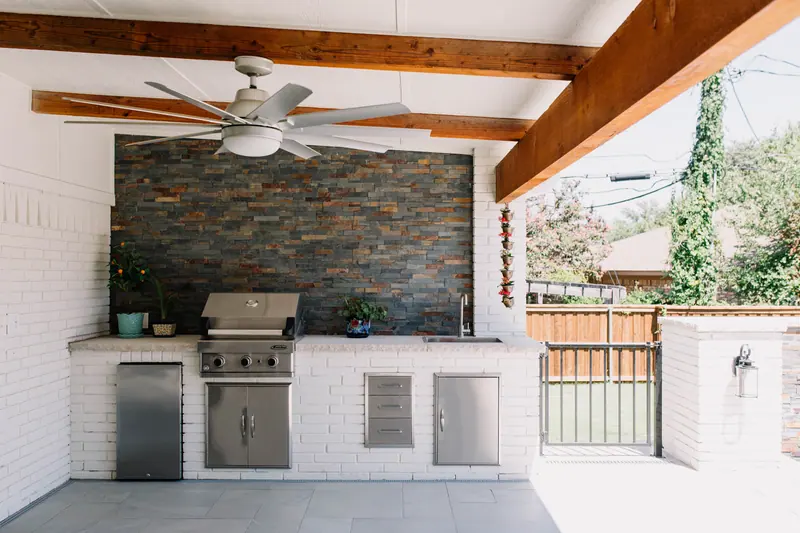
The Outdoor Kitchen — Where Budgets Get Real
This is where the conversation usually shifts.
A "basic" outdoor kitchen — a built-in grill, a counter, and a side burner — runs $15,000 to $25,000 installed in DFW. That's the entry point. Once you add a sink (which requires a plumbing line), a refrigerator (which requires an electrical line), a side burner, and decent stone or concrete counters, you're at $30,000 to $60,000.
Premium builds — pizza ovens, built-in beverage fridges, multiple grills, high-end ventilation, ice makers, full-coverage roof structure — push past $75,000 fairly easily. Some of the projects we see in Southlake and Westover Hills are six-figure outdoor kitchens. They look incredible. They also cost what a decent small kitchen renovation costs inside an actual house.
Here's the question we ask every client thinking about this: be honest, how often will you actually cook out here? Because the difference between a $20,000 grill island and a $75,000 full outdoor kitchen is about $55,000, and the question of whether you cook outside twice a month or twice a week is the only honest way to know which one makes sense.
The grill itself is the part most people overspend on. A $5,000 built-in grill cooks essentially the same as a $2,500 grill. The difference is brand prestige and a slightly nicer rotisserie. If you want to feel good about your outdoor kitchen for fifteen years, spend money on the cabinetry, the counter, and the coverage — those last forever and they're what makes the space feel like a real room.
The Covered Pavilion — When You Want a Real Outdoor Living Room
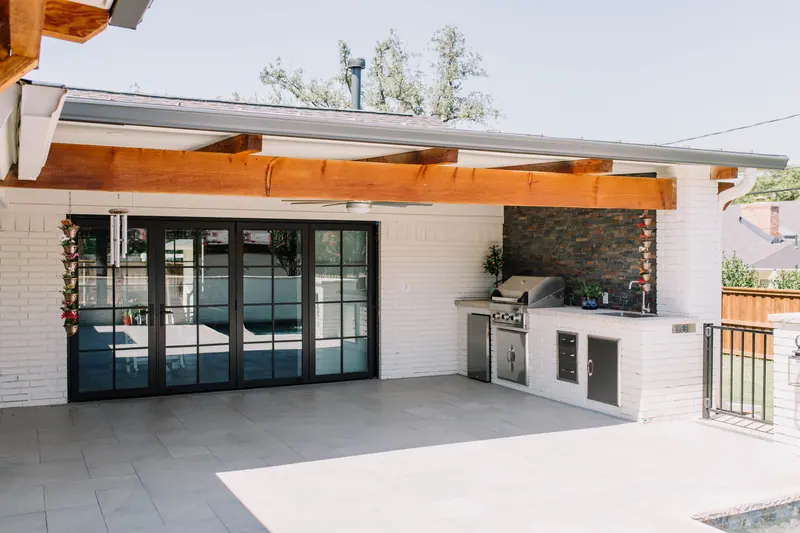
The next step up from a pergola is a covered pavilion — basically an outdoor structure with a real roof. Asphalt shingles or standing seam metal on top, framed by real posts, often with a flat or vaulted ceiling underneath.
In DFW for 2026, you're looking at $35 to $60 a square foot installed for the structure itself. A 14x16 pavilion lands in the $8,000 to $13,500 range. A 16x20 — which is closer to a "second living room outside" sized structure — runs $11,000 to $19,000. Tying a pavilion roof into your existing house roofline (rather than freestanding) adds engineering cost but creates a much more integrated look.
Where pavilions get expensive fast is when you start adding ceiling fans (essential in Texas — budget $500 to $1,500 each installed), recessed lighting, insulated ceilings (worth doing if you'll be running any AC nearby), and outdoor-rated speakers and TVs. A "loaded" pavilion with all the comfort features can land at $25,000 to $40,000 — but you're getting an actual outdoor living room, used 9 months a year in our climate.
The trend we're seeing for 2026: dark stains on the wood (black, charcoal, very dark walnut), exposed metal hardware, matte black ceiling fans, and integrated cable lighting in the beams. The "natural cedar with warm string lights" look that defined the 2020-2022 era is being replaced by something moodier and more architectural.